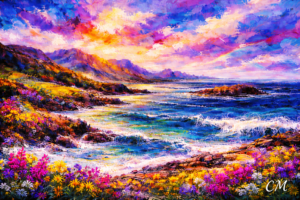
There is something about Scotland’s coastline that refuses to be ignored. The wind comes in sideways. The sea shifts from steel-grey to deep teal in a matter of minutes. Cliffs stand solid and ancient against restless water. It is raw, honest, and quietly powerful. For me, that wild edge between land and sea is where art begins.
Nature and marine-inspired abstract art is not simply about painting waves or skies. It is about capturing feeling — the stillness before a storm, the quiet after rain, the steady rhythm of tides. In Scotland’s coastal landscapes, peace is not always soft or pastel. Sometimes it is rugged. Sometimes it is carved into rock faces and weathered harbours. And that strength, that endurance, is deeply hopeful.
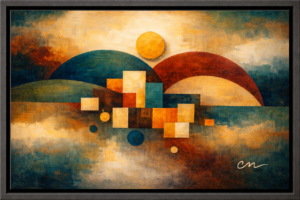
Abstract art allows space for interpretation. A sweep of deep teal may suggest the Atlantic rolling in. A soft wash of muted clay might echo sandstone cliffs along the west coast. Layered blocks of earthy red and ochre can reference the worn textures of rock, shaped by centuries of salt and wind. The forms are simplified, sometimes geometric, sometimes fluid, yet they carry the emotional imprint of real places.
Abstract realism, on the other hand, steps slightly closer to the landscape while still honouring expressive freedom. A lighthouse might emerge from layered colour. A suggestion of distant hills may appear beneath a fractured sky. The shoreline may be hinted at through strong horizontal lines and textured brushwork. It is recognisable, but not literal. It captures the essence of Scotland’s wild coastal identity without becoming a photograph.
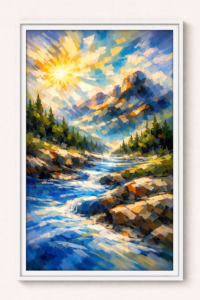
Across regions such as Isle of Skye, Outer Hebrides, and Firth of Clyde, the palette of nature offers endless inspiration. The sea is rarely just blue. It moves through indigo, turquoise, slate, and moss-green within a single day. The sky shifts from pale silver to dramatic violet as weather rolls in from the Atlantic. Coastal grasses bring muted greens and soft yellows, while rocky outcrops reveal rusty reds and warm browns.
These colours are not chosen at random in the studio. They are borrowed directly from the land and sea. Rich greens reflect moss clinging to stone walls. Deep teals mirror sheltered bays under heavy skies. Earthy reds and ochres recall cliff faces at sunset. Soft yellows suggest fragile light breaking through cloud. Even white space has meaning — it becomes sea spray, mist, or open air.
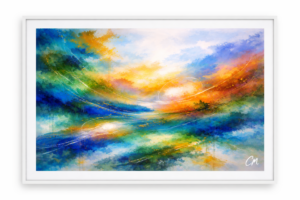
Texture plays an equally important role. In abstract realism especially, layered paint can echo the rugged surface of stone. Subtle impasto techniques give depth, allowing light to catch raised areas just as it would on rock or wave. Smooth, blended passages might represent calmer waters or expansive skies. The contrast between rough and smooth surfaces mirrors the balance found in nature itself — wildness alongside stillness.
Peace in this context is not about perfection. It is about balance. Scotland’s coastline is not manicured; it is weathered and authentic. Abstract compositions often reflect this through asymmetry and movement, yet still maintain harmony through colour relationships. Cool blues and greens are grounded by warmer earth tones. Bold shapes are softened by subtle blending. The result is artwork that feels alive but composed.
Hope emerges through light. In many marine-inspired works, a brighter focal area — perhaps a pale horizon or a streak of luminous yellow — draws the eye forward. It suggests possibility beyond the immediate foreground. In abstract realism pieces, a lighthouse or open stretch of water can symbolise guidance and continuity. Even in moody palettes, there is often a quiet glow somewhere within the composition.
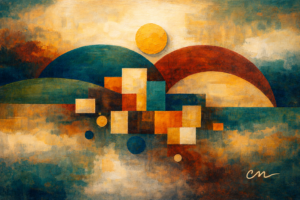
When translated into canvas framed prints, these artworks take on a new role. They move from studio expression to lived environment. A carefully framed canvas, particularly in white or soft neutral tones, allows the colours and textures to breathe. The depth of the frame adds dimension, casting gentle shadows that enhance layered paint. On a wall, the piece becomes a focal point — not loud or demanding, but grounding.
In calm, thoughtful spaces — living rooms, hallways, reading corners — marine-inspired abstract art can create an atmosphere of quiet reflection. The cool tones encourage relaxation. The earthy hues add warmth. The suggestion of sea and land reminds us of something larger and steadier than daily concerns. It is a visual exhale.
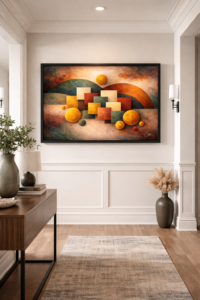
Scotland’s wild coastal landscapes offer more than dramatic scenery. They offer lessons in resilience, coexistence, and balance. Abstract and abstract realism artwork inspired by these environments carries that message into interior spaces. Through colour, texture, and thoughtful composition, it transforms rugged cliffs and restless seas into moments of calm and hope.
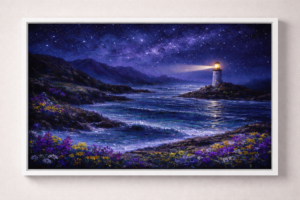
In the end, the goal is not to replicate Scotland’s coastline exactly. It is to honour its spirit — its strength, its shifting light, its enduring beauty — and to translate that spirit into artwork that brings peace into the places we live.