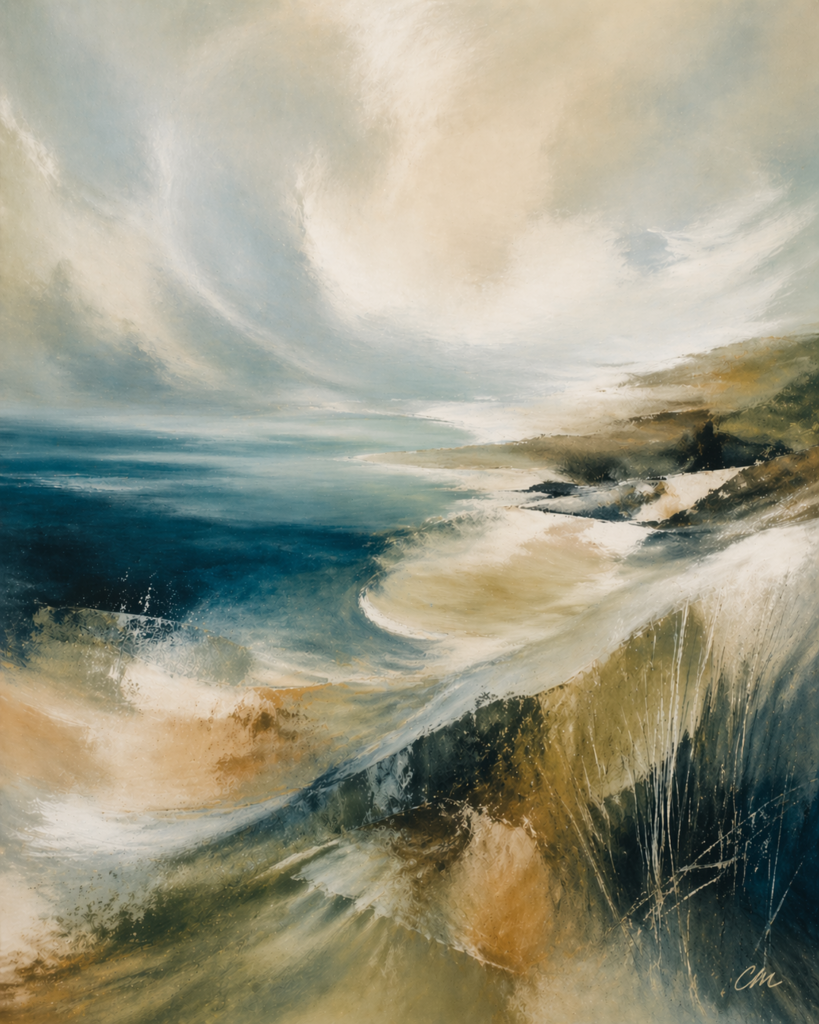
Nature-led abstract art is about more than colour, composition, or style. At its heart, it is about feeling.
It is rooted in the belief that art can do something quietly powerful. It can soften a room, calm the mind, and help people reconnect with something deeper than the noise of modern life. Inspired by land, sea, sky, weather, and the changing rhythms of the natural world, this kind of art invites stillness, reflection, and emotional connection.
For me, that is where the real value of abstract art begins.
Art as a Visual Exhale
One of the most important values in nature-inspired abstract art is restorative calm.
We live in a world that is often rushed, crowded, and full of demands. Many people long for their homes to feel like places of rest rather than more spaces filled with noise. Nature-led abstract art can help create that shift. Through layered textures, balanced movement, and thoughtful colour, a painting can bring a sense of quiet into a room.
It becomes a visual exhale.
Soft blues, muted greens, sandy neutrals, weathered earth tones, and misty light can all work together to create a feeling of ease. The goal is not to overwhelm the viewer. It is to offer space. Space to pause, breathe, and feel grounded again.
That calm is not empty. It carries presence. It carries atmosphere. It holds a kind of peace that many people recognise instinctively, even if they cannot immediately explain why.
Bringing the Outdoors In
Nature-led art is also shaped by a deep belief in our human need to connect with the natural world.
Even in modern interiors, surrounded by technology and daily pressure, people still respond to the colours and rhythms of nature. We feel better when we are close to open skies, water, wild places, and natural forms. This is why art inspired by the landscape can feel so powerful within the home.
It helps bring the outdoors in.
A painting does not need to describe every detail of a real place to do this. In fact, abstraction often allows for a deeper connection. A sweep of colour may suggest sea and sky. A textured surface may feel like stone, weather, or shoreline grasses. A shifting blend of light and shadow may recall a memory of a quiet walk, a tide line, or distant hills.
The painting becomes more than an image. It becomes an atmosphere.
Emotional Resonance Over Realism
This is why emotional resonance matters more than realism in nature-led abstract art.
The aim is not simply to paint a recognisable view. It is to capture the feeling of a place. The hush of early morning light. The movement of wind over coastal grasses. The mood of a wide shoreline under a changing sky. The stillness that comes when land and sea meet in silence.
That emotional truth matters more than literal accuracy.
When art focuses on atmosphere rather than exact description, it leaves room for the viewer’s own memories and emotions. One person may see a coastline. Another may feel a memory of a harbour, a beach, or a walk beside a loch. The work becomes personal without losing its own identity.
That openness is one of the great strengths of abstract art. It allows the viewer to enter the painting rather than simply look at it.
The Quiet Power of Awe
Nature-inspired artists are often drawn to the sublime.
That word speaks of awe, wonder, and the powerful emotions we feel in the presence of nature. In the past, the sublime was often linked to drama and danger. Storms, cliffs, and vast dark seas were painted to show nature’s overwhelming force.
Today, that feeling can take a gentler form.
It can be found in moody skies, shifting tide lines, weathered rock, mist, silence, and distance. It is still awe, but without the need for spectacle. It is the quiet beauty of the natural world when we take time to notice it fully.
This gentler sublime has a special place in contemporary interiors. People often want art that brings balance rather than more intensity. They want something emotionally rich, but also calming. Something that reminds them of the beauty and scale of the world without disturbing the peace of the space.
Patience, Observation and the Slow Process of Looking
Nature teaches patience.
Tides move in their own time. Light changes slowly across the day. Seasons arrive by degrees. Growth and decay happen quietly. Artists who are inspired by nature often work from this same sense of attentiveness. They observe small shifts in colour, texture, atmosphere, and mood. They notice what others may pass by.
That way of seeing shapes the work.
Nature-led abstract painting is often built through layers. Colours are added, softened, scraped back, and adjusted. Marks emerge slowly. Surfaces develop over time. The finished painting carries something of that process within it. It feels lived in rather than rushed.
This slower approach matters because it reflects the subject itself. If a painting is inspired by the natural world, it should carry some sense of natural rhythm. Not forced. Not hurried. But allowed to unfold.
Impermanence and the Beauty of Change
Another important value in nature-led art is the acceptance of impermanence.
Nature is always changing. Shorelines shift. Flowers fade. Light disappears. The tide comes in and wipes the sand clean. Nothing stays exactly as it is. Rather than resisting this, many artists find meaning in it.
There is beauty in what is passing.
Abstract art can hold that beautifully. A blurred edge, a worn texture, a softened layer, a half-hidden mark, all of these can suggest time, weather, and change. They remind us that life is not static. It moves through cycles of growth, rest, erosion, and renewal.
In a world that often pushes perfection, speed, and constant output, this feels important. Art that honours change can feel more honest. More human. More connected to the way life really is.
Environmental Care and Respect for Place
For many nature-led artists, a close connection to the landscape also brings a sense of responsibility.
To love the natural world is to notice its fragility. Coastlines, seas, habitats, and weather systems all carry signs of beauty, but also vulnerability. Art can reflect this awareness in quiet but meaningful ways. Through thoughtful choices, sustainable materials, and a genuine respect for place, artists can create work that not only celebrates nature but also honours it.
This does not always need to be stated loudly.
Sometimes care is expressed simply through attention, reverence, and the decision to create work that encourages people to value the natural world more deeply.
A Quiet Revolution in Feeling
Ultimately, nature-led abstract art offers something that many people are hungry for.
It offers calm without emptiness. Emotion without noise. Beauty without excess. It helps reconnect us to the land, the sea, the seasons, and our own inner stillness. It invites us to notice more, rush less, and feel more deeply.
In that sense, it is a quiet revolution.
Not a revolution of shouting or spectacle, but one of presence, atmosphere, and being. In a culture that constantly urges us to do more, move faster, and consume more, nature-led abstract art reminds us of the value of simply being still enough to feel.
And sometimes that is exactly what a space, and a person, needs most.