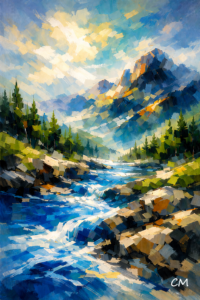
Abstract Realism in landscape art occupies a compelling space between faithful observation and emotional interpretation. It resists the idea that a landscape must be either a literal depiction of nature or a fully non-representational arrangement of shapes and colours. Instead, it allows the artist to anchor their work in recognisable terrain while freely distorting, simplifying, or exaggerating elements to convey mood, memory, or inner experience. This can be seen in my abstract realism painting Highland Spring, above.
At its core, abstract realism landscapes retain a sense of place. The viewer can usually identify hills, trees, coastlines, skies, or built environments. Horizons still exist, light still behaves in ways we recognise, and spatial depth often remains intact. However, these familiar elements are not treated as fixed truths. Forms may be flattened or stretched, colours intensified beyond naturalistic limits, and textures heightened to emphasise rhythm and movement rather than surface detail. As can be viewed with the way I have intensified the river colour in Highland Spring, above. The result is not an exact portrait of a location, but a psychological or emotional response to it.
Colour plays a particularly important role in abstract realist landscapes. Rather than mimicking nature, artists often use colour symbolically or expressively. A sky may be rendered in heavy purples or fiery reds to suggest tension, solitude, or drama, while landforms may dissolve into gestural marks that imply motion, erosion, or time. These choices shift the focus from what the landscape looks like to what it feels like to experience it. The landscape becomes less of a backdrop and more of an active emotional presence.
Texture and mark-making are equally significant. Loose brushwork, layered paint, scraped surfaces, or mixed media techniques introduce a tactile quality that mirrors the physicality of the land itself. Rough textures can echo rock, soil, or weathered surfaces, while smoother passages may suggest distance, atmosphere, or calm. In abstract realism, technique is not hidden; it is part of the language of the landscape, reinforcing the idea that perception is shaped by the artist’s hand and mind.
Unlike traditional landscape realism, which often aims for clarity and balance, abstract realist landscapes frequently embrace ambiguity. Details may dissolve at the edges, focal points may shift or blur, and scale can feel uncertain. I have intentionally blurred parts of Highland Spring to distort reality. This ambiguity invites the viewer to engage more actively with the work, filling in gaps with personal memory or emotion. The landscape becomes a shared space between artist and viewer, rather than a fixed, objective scene.
Abstract realism in landscape art ultimately challenges the notion that realism is about accuracy alone. Instead, it suggests that truth can be emotional, subjective, and layered. By blending recognisable environments with abstraction, artists create landscapes that reflect not just the external world, but the internal responses it provokes—memory, nostalgia, unease, wonder, or quiet contemplation. In doing so, abstract realist landscapes offer a deeper, more human vision of place, one shaped as much by feeling as by form.
I hope you like Highland Spring for its vibrant use of colour that can often be witnessed when visiting the highlands of Scotland.