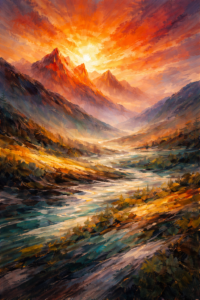
Landscapes, in their vast and varied forms, offer an inexhaustible well of inspiration for my abstract practice, not because of their literal appearance but because of the emotions and sensations they awaken. When I engage with a landscape, I am less concerned with documenting what is seen and more interested in translating how it is felt. Mountains, glens, meadows, and forests become starting points—emotional catalysts rather than subjects—allowing abstraction to capture the essence of place without relying on recognisable imagery.
The grandeur of mountains often inspires a sense of permanence and humility. In abstract landscapes, this might emerge through strong vertical forms, fractured planes, or sharply angled lines that convey weight and scale. These elements need not resemble mountains directly; instead, they suggest resistance, endurance, and geological time. Heavy textures, layered surfaces, and dense pigments can echo the slow accumulation of earth and stone, while negative space can imply vast skies or distant horizons. The emotional impact of standing before a mountain range—feeling both small and connected—finds its way into the composition through contrast and balance.
Glens and open landscapes invite a different emotional response: calm, openness, and continuity. These environments lend themselves to softer transitions, horizontal movement, and expansive fields of colour. In abstraction, gentle gradients and flowing shapes can suggest land unfolding into distance, encouraging the eye to wander rather than confront. Subtle shifts in tone reflect the quiet rhythms of nature—wind passing through grass, light changing slowly across the land—creating a meditative quality within the work.
Forested landscapes, by contrast, offer intimacy and enclosure. Their complexity and layered depth can be explored through overlapping forms, textured marks, and deeper, cooler colour palettes. Dark greens, blues, and earthy tones evoke shadow and stillness, while fragmented shapes hint at branches, undergrowth, and filtered light without defining them. These abstract interpretations mirror the experience of being within a forest—surrounded, sheltered, and immersed in something ancient and alive.
Colour becomes a powerful emotional language in abstract landscapes. A sudden burst of red or orange can represent the fleeting brilliance of dawn or sunset, moments when light transforms the land and heightens awareness. These vibrant accents act as focal points, punctuating quieter passages and suggesting energy, change, or transition. Cooler tones, such as deep blues or muted greens, slow the composition, evoking solitude, reflection, or the hush of twilight. Through these choices, colour moves beyond description and becomes a carrier of mood and memory.
Ultimately, abstract landscapes are about connection—between the inner and outer worlds, between the viewer and the Earth. By stripping away literal detail, abstraction invites a more personal engagement, allowing each viewer to project their own experiences and emotions onto the work. In this way, abstract landscapes do not depict nature; they resonate with it, offering a space for awe, wonder, and a renewed sense of belonging within the natural world.