Understanding Light and Dark
Abstract art often challenges viewers because it does not rely on recognisable objects or scenes. Without figures, landscapes, or clear narratives, meaning is created through visual elements alone. One of the most important of these elements is value. In abstract art, value refers to the lightness or darkness of a tone or colour, and it plays a crucial role in shaping how a work is experienced.
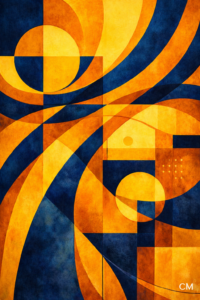
Value is essentially about light and dark. It exists independently of colour, yet it strongly influences how colour is perceived. A painting with limited colours, such as Golden Days above, can still feel powerful and complex if the values are varied and well organised. Conversely, an artwork with many colours may feel flat if the values are too similar.
It is because abstract art does not describe the visible world, value is used in an expressive rather than a realistic way. Instead of showing how light falls on an object, artists use light and dark areas to create mood, energy, and emotional tension. Dark values often feel heavy, grounded, or intense, while light values can suggest openness, air, or calm. These sensations arise instinctively, even when the shapes themselves have no identifiable meaning.
One of the key roles of value in abstract art is the creation of depth and space. Contrasting light and dark areas can suggest layers, movement, or recession within a flat surface. A dark form set against a light background may appear to advance, while softer value transitions can create a sense of quiet continuity. Through value alone, an artist can make a composition feel dynamic or still. I believe Golden Days achieves this feeling with its clever use of light and dark colours.
Value also plays a major part in contrast. High value contrast—strong differences between light and dark—creates drama and visual impact. It causes the eye to move quickly and decisively around the artwork. Low value contrast, where tones sit closer together, produces a more subtle and harmonious effect. These quieter compositions often feel contemplative, encouraging slower and more reflective viewing. Neither approach is superior; each supports a different emotional outcome.
Another important function of value is focus. The human eye is naturally drawn to areas where light and dark meet. In abstract art, a focal point is often established by placing a light shape against a dark field, or a dark form within a lighter space. For example, with Golden Days I used circles to guide the viewer’s eye. This allows the artist to guide the viewer’s attention without using recognisable imagery.
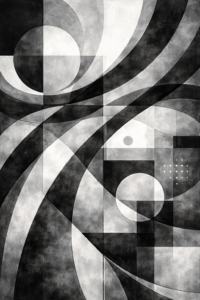
It is important to understand that colour and value are not the same thing. A colour that appears bright may still be dark in value, while a muted colour can be surprisingly light. For this reason, many artists examine their work in black and white to test its value structure. If the composition remains clear and balanced without colour, the underlying values are working successfully. Below is Golden Days without colour.
A helpful way to think about value is to see it as the emotional lighting of an artwork. If composition is the framework that holds an abstract piece together, value is what reveals and shapes that framework. Through light and dark, abstract art communicates feeling, movement, and depth—without ever needing to describe the world as it appears.