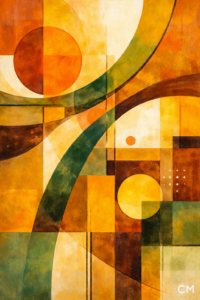
Understanding the Invisible Structure
Abstract art can often feel mysterious at first glance. Without familiar subjects like people, landscapes, or objects, viewers may wonder how to “read” it or what holds it together. This is where composition becomes essential. In abstract art, composition is the underlying structure that organizes visual elements and gives the artwork coherence, impact, and emotional power.
Composition refers to how an artist arranges the parts of an artwork within the space. In abstract art, these parts are not recognizable figures but elements such as shape, line, colour, space, texture, and movement. Together, they form an invisible framework that guides the viewer’s eye and shapes their experience of the piece.
Unlike realistic art, where composition often supports a clear subject or narrative, abstract composition is built on relationships. Colours relate to other colours, shapes respond to surrounding space, and lines create pathways for the eye to follow. Even works that appear spontaneous or chaotic usually rely on careful compositional decisions made by the artist, either consciously or intuitively.
One of the most important aspects of abstract composition is balance. Balance does not mean symmetry; instead, it refers to the distribution of visual weight. A small, bright shape may balance a larger, darker one, or a dense area of marks may be offset by open, empty space. This balance keeps the artwork from feeling unstable or unresolved.
Rhythm is another key principle. Repetition of shapes, colours, or lines creates a sense of movement and flow, much like a beat in music. Rhythm encourages the viewer’s eye to travel across the artwork rather than settling in one place.
Most abstract compositions also contain a focal point, even if it is subtle. This is an area that draws attention first, often through contrast, scale, or colour intensity. From there, the viewer’s gaze moves through the rest of the piece, guided by the artist’s compositional choices.
Contrast and tension play a major role in expressing emotion. Sharp lines against soft shapes, dark tones beside light ones, or calm areas interrupted by energetic marks all create visual drama. These contrasts give abstract art its expressive strength and emotional depth.
Finally, strong abstract composition achieves unity. Despite variety or complexity, the elements feel connected, as though they belong together. Unity does not require neatness or simplicity; even bold, layered, or seemingly chaotic works can feel unified when their elements relate harmoniously.
A helpful way to understand abstract composition is to compare it to music without lyrics. There may be no literal story, but structure, rhythm, tone, and emotion still shape the experience. In the same way, abstract art communicates through its composition rather than through representation.
In essence, composition is the backbone of abstract art. It transforms colours, shapes, and marks into a meaningful visual experience, inviting viewers not to search for objects, but to feel, explore, and respond.