Five Landscapes of Mystery, History and Light
By Clements McCulloch
Scotland’s castles have always fascinated me. Some stand proudly above the sea, others lie hidden among ancient woodland, while many survive only as weathered ruins overlooking lochs and mountains. Each has its own character, shaped not only by its architecture but also by the landscape surrounding it and the stories held within its walls.
When creating my Scottish Castles Collection, I wanted to capture something beyond the appearance of the buildings. I wanted each painting to suggest an atmosphere, an emotion and a sense of the history that makes these places so memorable.
The first five paintings in the collection feature Cawdor Castle, Dunvegan Castle, Castle Tioram, Urquhart Castle and Eilean Donan Castle. They are also featured in my illustrated book, The Hidden Secrets of Scottish Castles: Murder, Mystery, Betrayal and Royal Intrigue, published under the name Ian McCulloch.
Although all five paintings share an expressive, slightly abstract style with visible impasto-inspired brushwork, each has a different mood. The skies, colours and surrounding landscapes help tell five very different stories.
1. Cawdor Castle — Autumn’s Golden Secret
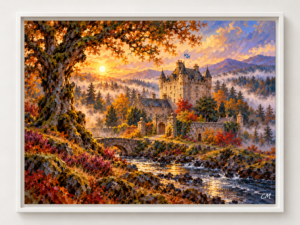
The painting of Cawdor Castle is dominated by warmth, rich autumn colours and the mysterious presence of an ancient tree.
A magnificent tree occupies the left foreground, its dark trunk and spreading branches framing the castle beyond. Its golden and russet leaves catch the light of a setting sun, while crimson undergrowth, rocky banks and a gently flowing stream lead the viewer towards the building.
The sky is filled with soft oranges, yellows and pale lavender tones. Rather than being completely calm, it has a textured, restless quality, suggesting the shifting light of a Highland autumn evening.
I wanted the overall atmosphere to feel welcoming but slightly mysterious.
Cawdor Castle is associated with the famous legend of a donkey, a tree and the unusual circumstances surrounding the choice of its building site. The tree in the foreground therefore becomes more than a decorative element. It provides a visual connection with the castle’s folklore.
The strong contrast between the ancient-looking tree and the illuminated stonework also creates a sense of time passing. Nature continues to grow and change while the castle remains a witness to generations of human stories.
The warm colours make this one of the more peaceful paintings in the collection, although the mist among the trees introduces a subtle feeling that something might remain hidden beyond the visible landscape.
For me, Cawdor is a painting about the relationship between nature, memory and legend.
2. Dunvegan Castle — Twilight Over the Isle of Skye
Dunvegan Castle has a very different atmosphere.
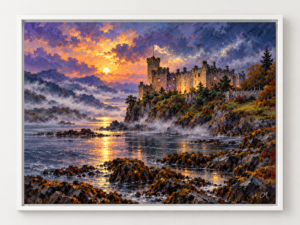
Here, the castle stands above a rocky shoreline, overlooking the waters of the Isle of Skye. Dark coastal rocks dominate the foreground, while the water reflects the final golden light of the evening.
The sky is especially important to this painting.
Warm peach, amber and gold around the setting sun gradually give way to violet, lavender and deep blue. The transition between these colours suggests the brief moment when daylight is disappearing and darkness is beginning to take control.
Mist lies among the distant mountains, softening their outlines and adding a sense of distance.
The castle itself is illuminated by the warm evening light, standing out against the cooler landscape. This contrast helps make the building the main focal point without allowing it to overpower the natural scenery.
Dunvegan Castle is closely associated with the Clan MacLeod and the legendary Fairy Flag, an object surrounded by stories of protection, danger and supernatural intervention.
I wanted the painting to reflect that combination of history and folklore.
There is a quiet mystery in the twilight sky. The atmosphere is not threatening, but it suggests that the castle belongs to a world where traditional stories remain closely connected to the landscape.
The expressive brushwork in the sea and clouds introduces movement, while the castle remains reassuringly solid.
This contrast between the changing natural world and the permanence of the building is central to the composition.
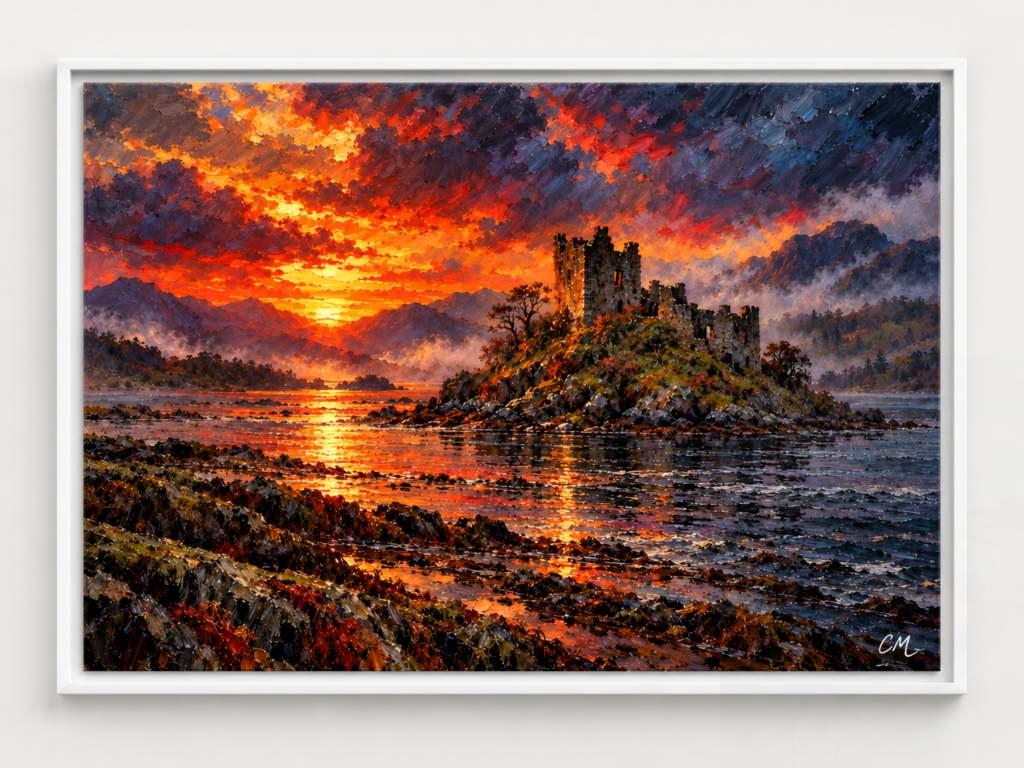
3. Castle Tioram — The Last Light of Moidart
Of the first five paintings, Castle Tioram is perhaps the most dramatic in its use of colour.
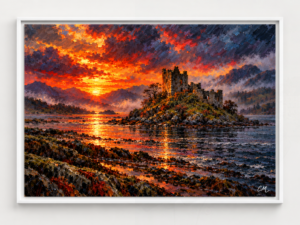
The ruined fortress stands on a rocky tidal island, surrounded by dark water and distant Highland mountains. Its weathered stone walls appear almost silhouetted against an extraordinary evening sky.
Deep crimson, fiery orange and brilliant gold sweep across the clouds, with darker blues and purples suggesting the approaching night.
The sun sits low above the horizon, sending a glowing reflection across the water towards the foreground.
I used this intense colour contrast to create a feeling of drama and finality.
Castle Tioram has a turbulent history, particularly its association with the Jacobite period and the tradition that its owner ordered it burned rather than allow it to fall into enemy hands.
That story influenced the emotional character of the painting.
The blazing sky can be interpreted as a symbolic reminder of destruction, sacrifice and the end of an era. Yet the castle still stands, even in ruins, suggesting endurance and survival.
The surrounding landscape reinforces the fortress’s isolation. The water forms a natural barrier, while the distant mountains make the setting feel remote and difficult to reach.
Thick-looking brushstrokes across the rocks, sea and clouds add energy to the composition.
Although the painting depicts a sunset rather than a historical event, I wanted viewers to sense something of the powerful emotions associated with the castle’s past.
Castle Tioram is a painting about isolation, defiance and the beauty that can remain after destruction.
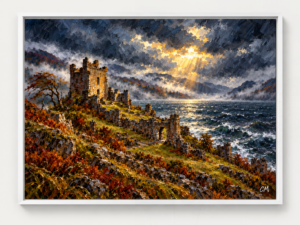
4. Urquhart Castle — Light Through the Storm
Urquhart Castle overlooks Loch Ness, one of Scotland’s most recognisable and mysterious landscapes.
For this painting, I deliberately chose a cooler, more restrained palette.
Dark blue-grey storm clouds stretch across the sky, while shafts of golden light break through an opening overhead. The sunlight illuminates sections of the ancient ruins and catches the movement of the water below.
The loch is far from perfectly calm. Its surface is broken by waves, painted with energetic strokes in deep blue, silver and grey.
In the foreground, autumn grasses and weathered stone introduce warmer browns, oranges and ochres.
The contrast between light and darkness is the central feature of the painting.
Urquhart Castle witnessed centuries of conflict and changing control during Scotland’s turbulent past. Its ruined walls are a reminder of military struggles, shifting loyalties and eventual destruction.
I wanted the storm clouds to suggest those difficult centuries without depicting a particular siege or battle.
The sunlight, however, provides another message.
Even after destruction, the ruins continue to attract visitors and inspire curiosity. The castle remains an important part of Scotland’s historical landscape.
The light breaking through the clouds therefore becomes a symbol of endurance and hope.
The composition is intentionally dramatic, but not entirely sombre. The illuminated stonework draws the eye towards the castle, while the surrounding landscape gives the viewer a sense of the scale and beauty of Loch Ness.
For me, this painting captures the idea that history contains both darkness and light.
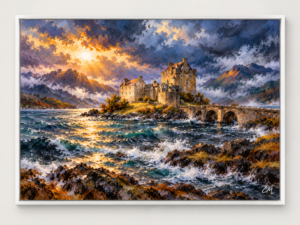
5. Eilean Donan Castle — Stormlight Over the Highlands
Eilean Donan Castle is one of Scotland’s most photographed historic buildings, yet I wanted my interpretation to offer something different from the familiar peaceful views.
The castle stands prominently on its small island, connected to the shore by its characteristic stone bridge.
Rather than surrounding it with still water and a clear sky, I chose a more energetic landscape.
Dark storm clouds gather above the mountains, while powerful shafts of golden sunlight illuminate the castle and the water around it.
The sea loch is filled with movement. Waves break against the rocks, creating flashes of white, turquoise and silver among the darker blues.
The surrounding mountains rise into drifting mist, giving the scene depth and an unmistakably Highland atmosphere.
The castle’s illuminated stone walls provide a strong focal point against the unsettled weather.
Eilean Donan’s history includes conflict, destruction and eventual reconstruction. The castle was heavily damaged during the Jacobite rising of 1719 and remained ruined for generations before being restored in the twentieth century.
This story of destruction and rebirth influenced my choice of light.
The storm represents the darker periods of its history, while the sunlight suggests survival, renewal and the castle’s continuing place in Scotland’s cultural imagination.
The bridge also plays an important compositional role. It leads the eye towards the building and creates a visual connection between the castle and the surrounding landscape.
I wanted the finished painting to feel powerful, dramatic and ultimately uplifting.
Bringing Scotland’s Castle Stories into the Home
Although these five paintings depict different castles, they share an underlying idea: a landscape can help tell a story without using words.
The autumn sunlight at Cawdor suggests legend and memory. Dunvegan’s twilight evokes the mysterious world of Highland folklore. Castle Tioram’s fiery sunset reflects defiance and loss. Urquhart’s storm clouds recall centuries of conflict, while Eilean Donan’s breaking sunlight celebrates survival and renewal.
My use of expressive colour, dramatic focal points and impasto-inspired texture is intended to give each painting an emotional quality beyond its architectural subject.
These are artistic interpretations rather than literal records of the landscape or historical events.
Each painting is available as a 16 × 12-inch landscape canvas print, with a white floating-frame presentation, as part of the Scottish Castles Collection at www.clementsmcculloch.com.
The stories behind the paintings can also be explored in my illustrated book, The Hidden Secrets of Scottish Castles: Murder, Mystery, Betrayal and Royal Intrigue, by Ian McCulloch.
Together, the book and the paintings offer two different ways of discovering Scotland’s extraordinary castles: through the written word and through the atmosphere of art.