
Composition is one of the most important elements in visual art. It refers to the deliberate arrangement, organisation, and placement of visual elements—such as line, shape, colour, texture, and value—within a piece of artwork. These elements work together to create a cohesive, balanced, and visually engaging image. Without thoughtful composition, even the most beautifully painted colours or detailed subjects can feel confusing or unstructured.
At its core, composition acts as the structural foundation of an artwork. It determines how the viewer’s eye moves across the image, where their attention is drawn first, and how the visual story unfolds. In many ways, composition is the silent guide that leads the viewer through the artist’s world. It shapes the flow of the piece, controls the sense of balance or tension, and influences the emotional response that the artwork evokes.
Understanding composition allows artists to move beyond simply depicting a subject and begin creating images that feel intentional, harmonious, and expressive.
The Role of the Focal Point
One of the key aspects of composition is the focal point. The focal point is the area of the artwork that attracts the viewer’s attention first. It is the visual anchor that holds the composition together and gives the viewer a place to begin exploring the image.
Artists create focal points in several ways. Contrast is one of the most effective methods. A bright colour placed among muted tones, a sharp detail surrounded by soft forms, or a light area within darker surroundings can naturally draw the eye. Placement also plays a significant role. Objects positioned strategically within the composition often become visual centres of interest.
Lighting can also create emphasis. In landscapes, for example, sunlight breaking through clouds onto a specific part of the land can guide the viewer’s attention to that illuminated area.
A well-placed focal point provides clarity and purpose. It ensures the viewer knows where to look first and prevents the composition from feeling scattered or unfocused. In the painting below, the focal point is the Cottage with smoke rising from the chimney. The invisible line that leads the viewer to the cottage might start with the red deer in the left foreground. Then the viewers eye travel across to the other two red deer on the other side of the stream. From there the eye goes to the cottage. The focal point. The only manmade structure in the entire scene. It stands out for that very reason, when you think about it.

Balance in Composition
Balance refers to the distribution of visual weight within an artwork. Just as physical objects must be balanced to stand upright, visual elements must be arranged carefully to prevent a composition from feeling awkward or unstable.
There are two main types of balance: symmetrical and asymmetrical.
Symmetrical balance occurs when elements are evenly distributed on both sides of a central axis. This type of composition often feels calm, formal, and stable. Classical architecture and traditional portraiture frequently use symmetrical balance to create a sense of order and harmony.
Asymmetrical balance, on the other hand, involves arranging elements of different sizes, colours, or textures in a way that still feels visually balanced. For example, a large shape on one side of a canvas might be balanced by several smaller shapes on the opposite side. This type of composition often feels more dynamic and natural, creating movement and interest. In the painting above, one large red deer on the left balanced by two smaller red deer on the right.
Both approaches are useful tools for artists, depending on the mood or message they want to convey.
The Rule of Thirds
Another widely used compositional guideline is the rule of thirds. This principle divides the canvas into a grid of nine equal sections using two horizontal and two vertical lines. Important elements of the composition are then placed along these lines or at their intersections. In the painting below, I used the rule of thirds to its full extent. Horizontally, the head of the red deer in the foreground is one third from the left handside. The head of the red deer in the mid ground is one third from the right handside, as is the cottage. Vertically, the red deer in the foreground is one third from the bottom. The focal point, the cottage, is two thirds from the bottom.

Placing subjects slightly off-centre often creates a more dynamic and visually appealing image than positioning them directly in the middle. The rule of thirds helps artists avoid static compositions and encourages a more balanced distribution of visual interest across the canvas.
Landscape painters frequently use this approach by placing the horizon along the upper or lower third of the canvas rather than directly across the centre.
Leading Lines and Visual Flow
Leading lines are another powerful compositional tool. These lines guide the viewer’s eye through the artwork, directing attention toward important elements or focal points.
Leading lines can take many forms. Roads, rivers, tree branches, fences, and shadows can all act as visual pathways within an image. In abstract art, lines created by colour changes, shapes, or brushstrokes can serve the same purpose.
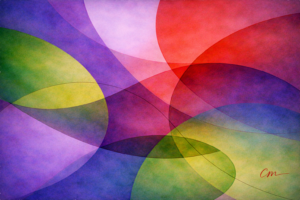
When used effectively, leading lines create a sense of movement and depth. They encourage the viewer to explore the artwork rather than simply glance at it. The painting above shows this effectively.
Types of Composition
Artists often use different compositional structures to create specific visual effects.
Static compositions tend to feel calm and orderly. These arrangements often use horizontal or vertical lines and balanced placements to create a sense of stability.
Dynamic compositions, by contrast, use diagonals, irregular shapes, and uneven spacing to introduce energy and movement. Diagonal arrangements in particular can create tension and excitement, making the viewer feel as though the image is alive with motion.
Chaotic compositions may intentionally disrupt balance and structure to evoke emotion, intensity, or unpredictability. While they may appear spontaneous, even these arrangements usually involve careful artistic decisions.
Composition as Visual Language
Ultimately, composition functions as the visual language of art. It allows artists to organise shapes, colours, and forms in a way that communicates meaning and emotion without the use of words.
Whether in painting, photography, sculpture, or digital art, strong composition transforms individual elements into a unified whole. It guides the viewer’s experience, strengthens the story within the artwork, and gives the image its sense of harmony and purpose.
For artists, learning to understand composition is not simply about following rules. It is about developing an awareness of how visual elements interact and how those interactions shape the viewer’s perception.
When composition is thoughtfully applied, the result is artwork that feels balanced, engaging, and deeply expressive.