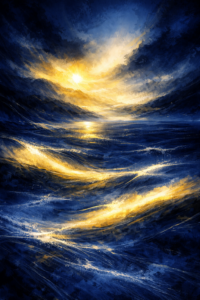
The reason for painting Storm at First Light is that I regard the seascape as a living, breathing expanse—an arena where motion, light, and atmosphere are in constant negotiation. It is not a fixed view but a moment caught mid-transition, where the horizon wavers between certainty and dissolution. This instability is what draws me to the sea as a foundation for abstraction. In the image, the boundary between sky and water feels porous, almost interchangeable, inviting interpretation rather than definition. I respond to this ambiguity by allowing forms to drift, blur, and overlap, echoing the way the ocean refuses to be contained.
The waves carry an energy that is both rhythmic and unruly. Their movement is suggested less through detail than through direction—sweeping gestures that rise and fall across the surface. In my abstract response, these motions become broad, confident strokes that surge forward, then recede, mimicking the breath-like pulse of the tide. At times, the water appears calm, its surface smoothed into long, fluid shapes; elsewhere, it tightens and fractures, hinting at an undercurrent of tension. This contrast allows the work to hover between serenity and unease, much like the sea itself.
Colour plays a central role in translating what I see into what I feel. Subtle tonal shifts—cool blues dissolving into muted greys, or warmer hues bleeding in from the sky—suggest the time of day as first light. Dawn and dusk are especially potent moments, when light is neither fully present nor fully gone. In abstraction, these transitions become layered fields of colour, softened edges, and translucent washes that allow one tone to seep into another. The result is not a literal sky or sea, but an atmosphere—something sensed rather than observed.
Light dances across the water in fleeting fragments, breaking and reforming with each wave. I interpret this interplay through contrast: sharp flashes against deeper, weighted passages. These moments of brightness feel like interruptions, reminders of movement and change, while darker areas ground the composition, anchoring it in depth. Together, they create a visual rhythm that mirrors nature’s unpredictability.
Beyond its physical presence, the sea in the image suggests vastness—an openness that dwarfs the human perspective. This immensity becomes symbolic in my work, a quiet reflection on scale and interconnectedness. The sea is not just a subject but a metaphor: for time, for emotion, for the unseen forces that shape existence. Through abstraction, I aim to move beyond representation and into resonance, inviting the viewer to linger, to contemplate, and to find their own meaning within the shifting, boundless space of the seascape.